




























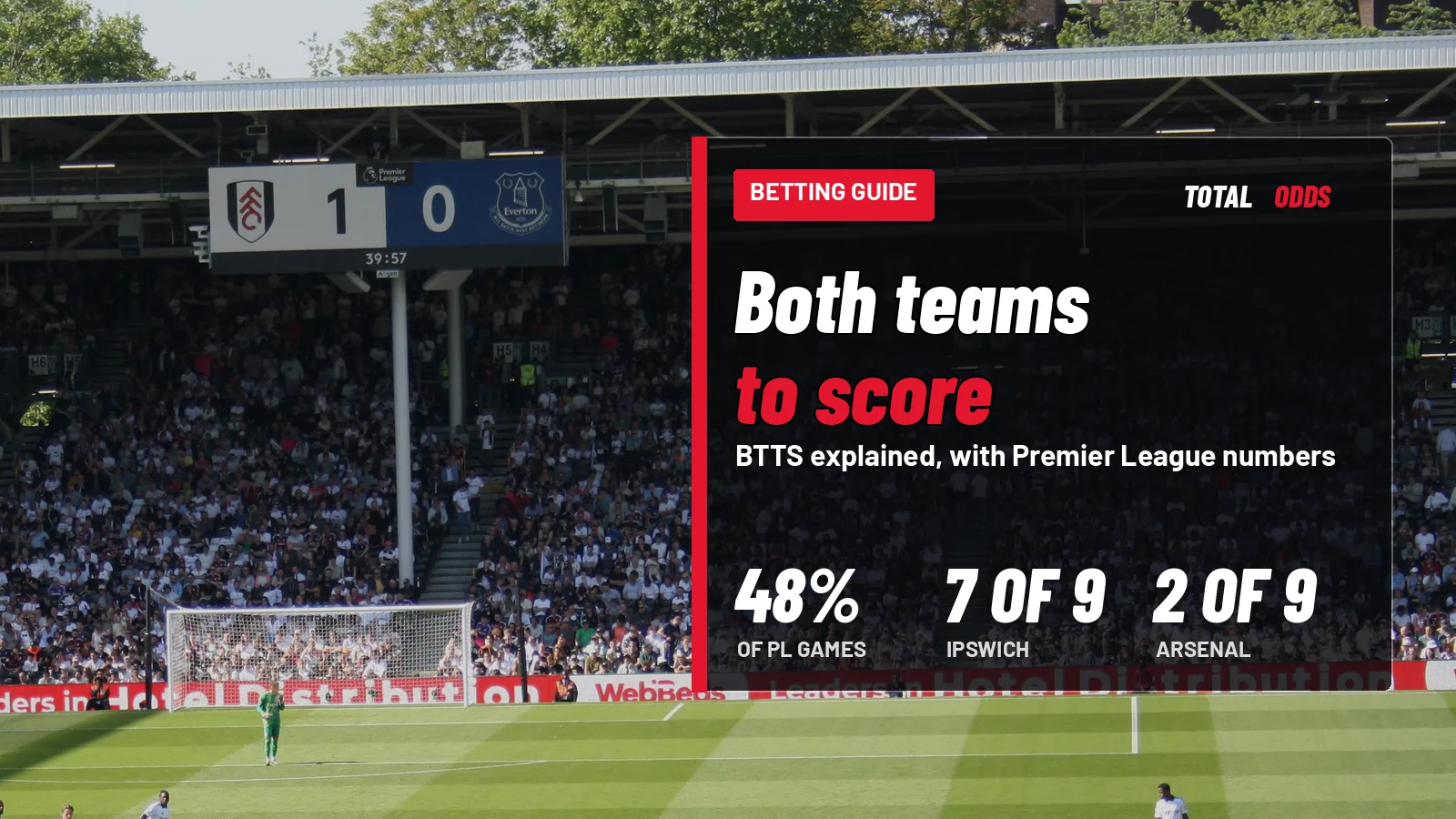
Both teams to score is one of the first markets most bettors try, and one of the easiest to misread. The bet itself is simple: it wins if each side scores at least once. The trouble is that a price such as 1.77 looks like a verdict when it is really a claim about two attacks and two defences at the same time. This guide explains how BTTS settles, how to turn its price into a percentage and where the Premier League numbers say it lands most often. The price examples come from Birmingham against Swansea in the Championship, where our fixture page carries a full set of bookmaker prices, and the club figures come from our Premier League BTTS table.
What both teams to score means
A BTTS Yes bet wins if both teams score at least one goal in normal time, which includes stoppage time. Extra time and penalty shoot-outs do not count. BTTS No wins if either side fails to score, so 0-0, 1-0 and 3-0 are all No results, while 1-1 and 4-3 are both Yes. The number of goals makes no difference, and that is what separates this market from over 2.5 goals. A 3-0 win goes over 2.5 but loses BTTS Yes, and a 1-1 draw does the opposite. Own goals are usually credited to the side that benefits, but bookmakers' rules differ, so check yours before you bet. Combinations such as BTTS and over 2.5 goals, or BTTS and a match result, are separate markets with longer prices, because every extra condition is harder to land.
How to read the price
On our Birmingham v Swansea fixture page, updated at 22:51 UTC on Friday 6 November, six bookmakers were quoting BTTS for Saturday's 15:00 UTC game. The best Yes price was 1.77 at Bwin and the best No price 2.05 at Betfair. Divide 100 by each price and you get 56.5 per cent for Yes and 48.8 per cent for No. Those add up to 105.3 per cent, and the surplus over 100 is the bookmaker's margin. At a single bookmaker it is larger: Bet365's 1.72 and 2.00 add up to 108.1 per cent. The method is the same one we walk through in our guide to reading football odds. The useful part is the comparison. Our page puts the Championship's BTTS rate at 56 per cent, so a Yes price implying 56.5 per cent is the market saying this game is roughly typical. The pair's head to head says otherwise: both teams scored in six of their last eight meetings.
What the Premier League numbers say
Both teams have scored in 48 per cent of Premier League matches this season, after 10 rounds. Without any margin, that rate would be a price of about 2.08. Ipswich lead our BTTS table, with Ipswich matches producing goals at both ends in seven of nine games. Brentford are next on six of nine. At the other end, Arsenal and Brighton have each had it in only two of nine, or 22 per cent. The table has Overall, Home and Away views, and the splits can be sharp. Aston Villa have had both teams score in four of five home games, while Nottingham Forest have failed to score in any of their four at the City Ground. Samples this small can swing quickly, so treat them as a prompt for a closer look and not a rule.
Scored in, conceded in
The most useful columns in the table are the two next to the BTTS count: how often a club has scored, and how often it has conceded. BTTS needs both sides to do each, so the weaker of the two numbers sets the ceiling. Ipswich have scored in 78 per cent of their games and conceded in all nine, which is exactly why they top the list. Arsenal have scored in 89 per cent but conceded in only three of nine, with six clean sheets, and that is why they sit near the bottom. Man United show the other way a club can drop out. They have conceded in every game, but they have failed to score in four of nine, so only five games have been BTTS. When you look at a fixture, ask which side is likelier to be the one that doesn't score, because that side decides the bet.
What can go wrong
BTTS Yes is a market that one goalless half of the game can wreck. A team that goes 1-0 up may drop deeper and shut the game down, a red card can make a game lopsided, and a 0-0 is an instant loss however many chances there were. No also has its risks, because one late consolation goal turns a comfortable-looking game into a loser. Margin matters on top of that. Across the six bookmakers on our page, the Yes price ran from 1.72 to 1.77, and a few hundredths on every bet adds up over a season. Samples matter too: nine or ten games per club is a short run. Check team news as well, because a missing striker or a goalkeeper change moves this market more than most. None of this makes the market unbeatable or safe.
Using our pages to check a game
Start with the Premier League BTTS table and its home and away views, then open the fixture page for the game. The head to head panel shows how often both sides have scored in past meetings and compares it with the league rate. For Birmingham v Swansea that is 75 per cent against 56. Prices for BTTS, double chance, draw no bet, total goals, Asian handicap and corners sit in a card further down the Birmingham v Swansea fixture page, with every bookmaker side by side. At the time of writing the card was live on Championship pages, while our Premier League fixture pages did not carry prices for these markets. Prices move, so check the time shown on the page before you use one.
Bet responsibly
Odds are a bookmaker's view of the chances, not a promise, and no market removes the risk of losing. Only bet what you can afford to lose, set limits before you start, and never chase losses. Betting is for over-18s. If gambling stops being fun, contact the National Gambling Helpline on 0808 8020 133 or visit BeGambleAware.org. More about how TotalOdds works is on our about page.
Photo credits
The cover shows the scoreboard and stand at Craven Cottage during Fulham v Everton on 10 May 2025. Photograph by Timmy96, CC0, via Wikimedia Commons, cropped and adapted with text. The second picture shows Fulham goalkeeper Bernd Leno during Fulham v Newcastle United on 24 May 2026. Photograph by Timmy96, CC0, via Wikimedia Commons, cropped.