

















































































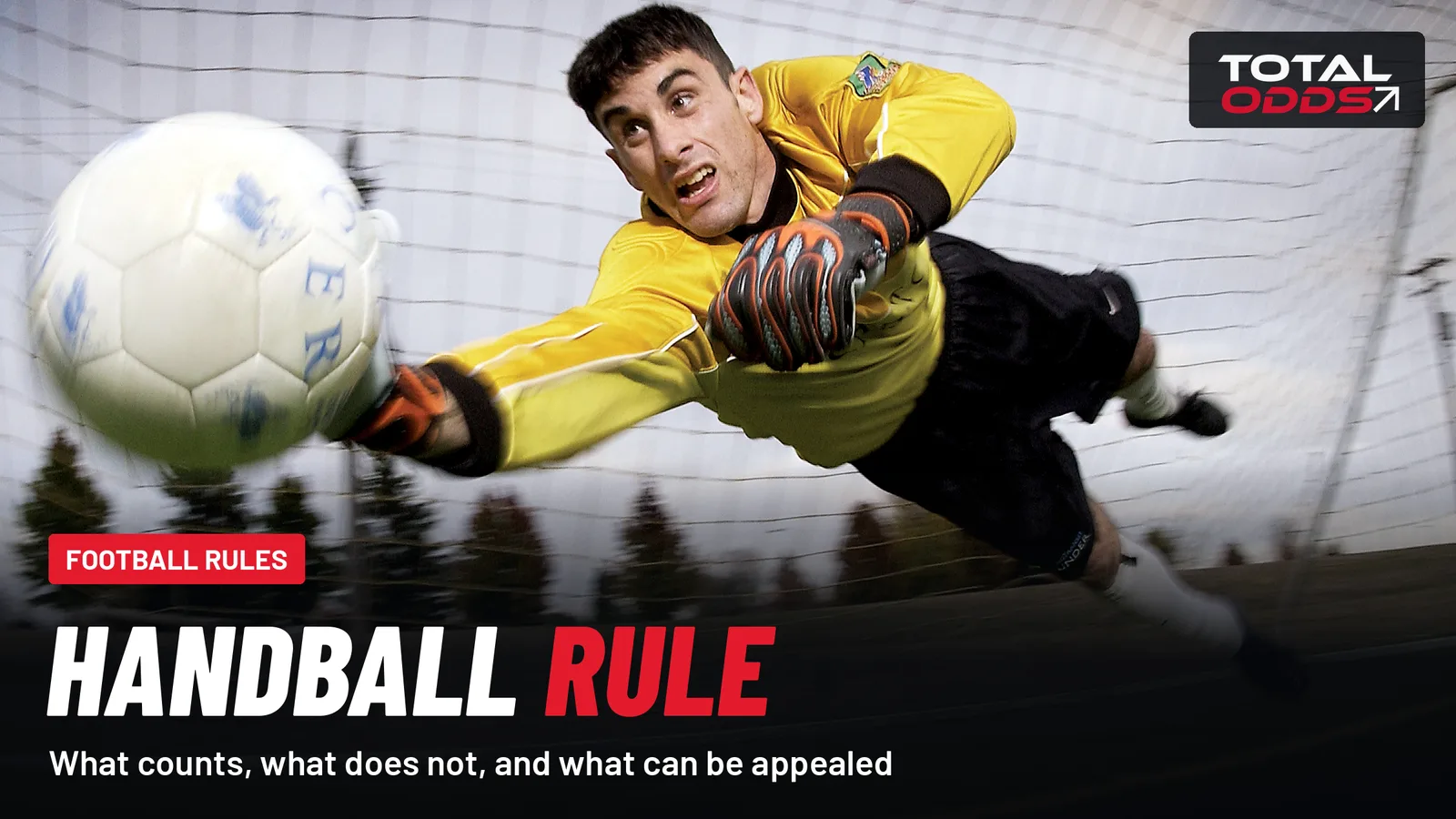
The handball rule says a player commits an offence by deliberately touching the ball with a hand or arm, by touching it with a hand or arm that has made their body unnaturally bigger, or by scoring in the opponents' goal directly from a hand or arm, or immediately after the ball has touched it, even by accident. Not every contact between ball and arm is a hand ball.
This guide follows the 2026/27 Laws of the Game, set by the International Football Association Board (IFAB). Handball sits in Law 12, which covers fouls and misconduct.
What is the handball rule in football?
A handball offence happens when a player does any of the following while the ball is in play.
- Deliberately touches the ball with a hand or arm. Moving the hand or arm towards the ball is one example.
- Touches the ball with a hand or arm that has made the body unnaturally bigger. This means the position of the hand or arm is not a result of, or justified by, the player's body movement in that situation. A player who holds an arm there takes the risk of being penalised.
- Scores in the opponents' goal directly from a hand or arm. This applies even if the contact is accidental, and it applies to goalkeepers too.
- Scores in the opponents' goal immediately after the ball has touched their hand or arm. Again, accidental contact counts.
The first rule is about intent. The other three can be broken without meaning to handle the ball. Goalkeepers have separate rules inside their own penalty area, explained below.
Where does the arm start?
For handball, the top of the arm is level with the bottom of the armpit. Contact with the hand or the arm below that line can be an offence. The shoulder is not part of the arm, so a player may control the ball or score with it, whether on purpose or not.
What counts as a hand ball?
For outfield players, and for goalkeepers outside their own penalty area, these are offences:
- deliberately touching the ball with a hand or arm, for example by moving it towards the ball to block, control or redirect it;
- using a hand to keep possession or carry on an attack;
- picking up or grabbing a ball that is still in play, including after wrongly assuming a free kick has been given;
- handling a ball to stop it going out of play;
- blocking the ball with an arm stretched away from the body when the arm is not supporting the player or explained by their movement;
- scoring in the opponents' goal directly from the hand or arm, or immediately after it has touched the ball, however accidental.
What is not a handball offence?
Play should normally continue in these cases:
- the ball hits an arm held close to the body that has not made the body unnaturally bigger;
- a defender pulls an arm into the body to avoid the ball and it still makes contact there;
- a player slips or falls and the ball touches a hand as part of that natural movement;
- a player kicks the ball and it accidentally comes off their own arm;
- a team-mate standing close plays the ball unexpectedly into a defender's arm;
- the ball strikes the shoulder, above the bottom of the armpit.
Context matters. A goal scored in the opponents' goal by the player whose arm touched the ball immediately beforehand is disallowed, even when the contact would be harmless elsewhere on the pitch.
When is the arm in an unnatural position?
The Laws set no fixed angle or distance. The referee asks whether the hand or arm position can be explained by what the player was doing at that moment. Running, jumping, turning and falling all move the arms, so an arm away from the body is not automatically an offence. If the ball hits an arm that makes the body bigger without that justification, it is an offence.
How the Premier League applies the handball rule
The Premier League asks its match officials to take a "less is more" approach to penalising handball in 2026/27. This is guidance on applying the law, not a separate law, and other competitions may describe their approach differently.
Likely to be given as handball:
- A deliberate arm movement away from the body
- Leaning deliberately to block the ball with the arm
- A clear extra movement of the arm
- An unjustifiable arm position that makes the body bigger
Points against handball:
- An arm position or action that can be justified
- An arm supporting a player who is falling
- A player playing the ball onto their own arm
- The ball clearly changing path after touching the same player
- The ball being played into the arm by a team-mate
- The ball arriving from close range
A very clear deflection that significantly changes the ball's path should count for more than the position of the arm. Even so, the ball touching another part of the body first does not automatically rule out a handball.
A player does not have to keep their arms pinned to their sides or tucked behind their back. An arm raised above the head when the ball strikes it, however, is the kind of position that can be judged unjustifiable.
Handball and goals: when is a goal disallowed?
By the scorer: if the ball goes in directly from an attacker's hand or arm, or the attacker scores immediately after it touches their hand or arm, the goal is ruled out. Intent and arm position make no difference. The defending team gets a direct free kick.
By a team-mate: accidental contact by one attacker before another scores is not an offence, provided the arm has not made the body unnaturally bigger. The same applies when accidental contact leads to a chance for a team-mate. A deliberate touch, or one with an unnaturally positioned arm, is still penalised.
After another pass: if an attacker accidentally touches the ball with an arm that has not made the body unnaturally bigger, passes to a team-mate, receives it back and scores, the goal stands.
By a defender: the ban on scoring with the arm applies to attacking players. If a defender heads the ball onto their own arm and it goes directly into their own goal, the goal counts.
Goalkeeper handball rules
Outside their own penalty area, goalkeepers have the same handball restrictions as everyone else.
Inside the area they may handle the ball, with these exceptions. The other team gets an indirect free kick if the goalkeeper:
- releases the ball and touches it with a hand or arm again before another player has touched it;
- handles a ball deliberately kicked to them by a team-mate, even if the pass was badly hit;
- handles the ball directly from a team-mate's throw-in.
The last two do not apply if the goalkeeper has first clearly kicked, or tried to kick, the ball to release it into play. If a team-mate was trying to pass to someone else and slipped, the goalkeeper may handle the ball, because it was not deliberately kicked to them.
A goalkeeper who parries a shot, or has the ball rebound off them, may handle it again before anyone else touches it. The same is true if a catch accidentally slips from their grasp. A goalkeeper who catches the ball and then deliberately puts it down may not pick it up again before another player touches it.
These offences inside the area carry no card. The exception involves a restart: a goalkeeper who plays the ball a second time before anyone else touches it must be cautioned or sent off if that stops a promising attack or denies a goal or an obvious goal-scoring opportunity.
Controlling the ball with the hands or arms for more than eight seconds is penalised differently: the opponents get a corner kick. The referee visibly counts down the last five seconds. There is no card unless the goalkeeper keeps doing it.
What is the punishment for a handball?
A handball offence is punished with a direct free kick. If a defending player commits it inside their own penalty area, it is a penalty kick. This does not depend on whether the offence was deliberate. The goalkeeper offences above are the exception.
A card depends on intent and on what the handball prevented. "DOGSO" below means denying a goal or an obvious goal-scoring opportunity. "Non-deliberate" still describes an offence, such as an arm that made the body unnaturally bigger.
No card
- No attempt to score, and no promising attack or goal-scoring chance affected
- Non-deliberate handball, given as a penalty, that stops a promising attack
Yellow card
- Handball that stops or interferes with a promising attack, unless it is non-deliberate and given as a penalty
- Attempt to score with the hand or arm, successful or not
- Non-deliberate DOGSO punished with a penalty
Red card
- Non-deliberate DOGSO outside the player's own penalty area
- Deliberate DOGSO, anywhere on the pitch
The two DOGSO red cards do not apply to a goalkeeper handling inside their own penalty area.
Advantage can change the card. If the referee plays advantage after a DOGSO handball and the attacking team scores as a result, the offender receives no card. If no goal follows, the player is cautioned. So a defender who tries and fails to keep the ball out with an arm is not booked when the goal is allowed. When advantage is played after a handball that stopped or interfered with a promising attack, there is no caution for it.
In the professional game in England, a red card for denying a goal or goal-scoring opportunity by handball carries a one-match ban for a first dismissal of the season. See our guide to red card suspensions for how repeat offences work.
Handball rule examples
These match situations show how the law is applied.
Play on
- A defender moves an arm in against the chest to avoid a shot, but the ball still hits it: play on.
- A defender slips and a hand touches the ball in a natural fall: play on.
- A defender's clearance accidentally comes off their own arm in the penalty area: play on.
- A defender's clearance unexpectedly hits a nearby team-mate's arm: play on.
- A goalkeeper parries a shot, then gathers the rebound: play on.
Goals given and ruled out
- An attacker controls a long pass accidentally with an arm and scores at once: no goal, free kick.
- The ball accidentally hits an attacker's arm and goes straight in: no goal, free kick.
- The ball accidentally touches an attacker's hand, and a team-mate immediately scores: goal, if the arm was not unnaturally placed.
- An attacker's unnaturally placed arm touches the ball before a team-mate scores: no goal, free kick.
- The ball goes in off an attacker's shoulder: goal.
- A defender handles on the goal line but the ball still goes in: goal, no card.
Free kicks, penalties and cards
- A sliding defender blocks a pass with an arm stretched out and not supporting them: free kick or penalty.
- A defender deliberately handles in their own area and stops a certain goal: penalty and red card.
- A defender's unnaturally placed arm accidentally keeps a goal-bound shot out in their own area: penalty and yellow card.
- A defender's unnaturally placed arm accidentally stops a promising attack in their own area: penalty, no card.
- A defender deliberately handles in their own crowded penalty area, with no promising attack or clear chance affected: penalty, no card.
- An attacker deliberately handles to keep a promising attack going, without trying to score: free kick, yellow card at the referee's discretion.
- A defender picks up a live ball in their own area, wrongly assuming a free kick: penalty.
- In their own area, a goalkeeper handles a pass deliberately kicked to them by a team-mate, without first trying to kick it: indirect free kick, no card.
Can VAR overturn a handball decision?
Yes, but only in certain situations. In matches using a video assistant referee (VAR), the VAR can help only with a clear and obvious error or a serious missed incident involving:
- a goal or no goal, including a handball in the attacking move;
- a penalty or no penalty;
- a red card, including a clearly wrong second yellow card;
- mistaken identity, where the wrong player is cautioned or sent off;
- a clearly wrong corner, in competitions that choose to review them, if it can be changed at once without delaying the restart. The Premier League has not adopted this option.
A free kick for handball in midfield cannot be reviewed by itself. A first yellow card is not reviewed in its own right, except for mistaken identity, although it can change when the referee reviews a penalty or a possible red card.
The referee makes the first decision and the final one. A judgement call on handball is suited to an on-field review at the pitchside screen. A factual question, such as exactly where the ball made contact, can usually be settled on the VAR's advice. Slow motion is generally for facts such as the point of contact, while normal speed should be used to decide whether it was an offence.
Players and coaches have no need to request a review under the VAR protocol, because every relevant incident is checked automatically. Excessively making the screen signal brings a caution, as does entering the referee review area. Once play has stopped and restarted, a handball decision cannot be reviewed, although mistaken identity and certain serious misconduct still can be.
Can a handball decision be appealed?
A club can challenge some disciplinary consequences, but it cannot appeal a referee's handball judgement to have a penalty or goal decision reversed.
During the match
On matters of fact in a match, such as whether a goal was scored and the final result, the referee's decision is final. The referee can correct a restart decision only before play restarts, and cannot do so after ending a half and leaving the field, or abandoning the match. Going to the VAR screen or calling the players back out does not count as leaving for this purpose.
Players who show dissent can be booked. IFAB's "only the captain" guidelines let one player per team, usually the captain, approach the referee respectfully after a major decision. Competitions can apply them now, and the guidelines become compulsory for competitions starting on or after 1 July 2027.
After the match
Disagreement with the referee's judgement over a penalty, free kick or disallowed goal does not reopen the result. Under the VAR protocol, a match is in principle not invalidated because of a wrong decision involving VAR or a decision not to review an incident.
Red and yellow card appeals in England
In the professional game, a club that believes a straight red card was an obvious error can claim wrongful dismissal. The typical process is:
- Tell the FA by 1pm on the first business day after the match that a claim is coming.
- Send the evidence by 1pm on the second business day.
- A Regulatory Commission considers video and written evidence. The club must show that the referee made an obvious error, including after any VAR involvement.
- If the claim succeeds, the suspension is withdrawn at once. The sending-off stays on the record but does not count if the player is dismissed again that season.
- If it fails, the ban remains. The commission can increase the punishment, by up to twice the standard amount, if the claim had no prospect of success or abused the process.
Timetables are shortened when matches are close together.
A wrongful dismissal claim is not available for a yellow card or for a dismissal for two yellows. A club can instead claim mistaken identity if the wrong player was booked or sent off. It follows the same 1pm deadlines and needs a signed statement from the player originally reported, confirming they were not responsible and naming who was. If upheld, the punishment moves to the correct player.
The FA can also act after a match if a player deceived the officials by handling the ball in a direct and successful attempt to score. A proven case carries an automatic two-match ban.
UEFA and FIFA competitions
In both, the referee's decisions on the field are final and cannot be reviewed by disciplinary bodies, apart from the limited cases below. Where there is an obvious error, such as mistaken identity, only its disciplinary consequences can be reviewed. A protest against a yellow card, or a dismissal for two yellows, is admissible only on mistaken identity.
- Who can protest: member associations and clubs, in both.
- Deadline: 24 hours after the match, in both.
- UEFA fee: €1,000, returned if the protest is admitted.
- FIFA fee: CHF 1,000, returned if the protest is admitted in full.
Competition rules can shorten the deadline. Permitted grounds include an ineligible player, an unfit pitch reported at the proper time, and the disciplinary effects of an obvious refereeing error.
UEFA also allows protests over an obvious breach of a rule by the referee that had a decisive influence on the result, or another significant incident with that influence. Factual decisions by the referee still cannot be protested.
A party directly affected by a first-instance UEFA disciplinary ruling generally has three days from the issue of the decision with written reasons to declare an appeal, followed by five more days to file the grounds. The appeal fee is €1,000. Written reasons must be requested in time, and competition rules may shorten the deadline. No appeal is allowed if the measure is limited to a warning, a reprimand or an automatic one-match suspension.
Premier League incident reviews
The Premier League's Key Match Incidents Panel assesses major refereeing and VAR decisions after matches. It has five members: three former players or coaches, one Premier League representative and one from Pro Ref, the referees' body. Its published verdicts can say a handball call was wrong, but they are an assessment, not an appeal that changes the score.
Handball rule questions
Is accidental handball an offence?
It can be. Accidental contact is an offence if the arm has made the body unnaturally bigger, or if the player scores in the opponents' goal directly from it or immediately afterwards.
Is every hand ball in the box a penalty?
Every handball offence by a defending player in their own penalty area is a penalty. Other contact is not penalised, and goalkeepers follow separate rules.
Is handball always a yellow card?
No. Many offences bring only a free kick or penalty. Cards depend on intent, any attempt to score and the attack or chance affected.
Can you score with your hand in football?
No. A ball sent directly into the opponents' goal by a hand or arm does not count, even if accidental, and this includes goalkeepers.
For more on discipline, read our guides to yellow card suspensions and booking points, or compare officials on the Premier League referees page and clubs in the Premier League cards table.