

















































































A red card in English football costs a player between one and six matches, and the offence decides which. A second yellow card or denying an obvious goal-scoring opportunity means one match. Offensive, insulting or abusive language or gestures means two. Serious foul play and violent conduct mean three, and spitting means six. A player sent off for a second time in the same season sits out one extra match on top, and a third dismissal adds two.
These are the FA's standard punishments for 2026/27, and they apply to every club in the Premier League, the EFL and the National League. Here is how they work, which games a ban covers and when it can be cut or increased.
How many matches for each red card?
The table below is the FA's list for first-team players. The ban is automatic, so nobody has to charge the player.
| Sending-off offence | Standard ban |
|---|---|
| Second yellow card in the same match | 1 match |
| Denying an obvious goal-scoring opportunity with a foul | 1 match |
| Denying a goal or an obvious goal-scoring opportunity with a handball | 1 match |
| Offensive, insulting or abusive language or gestures | 2 matches |
| Serious foul play | 3 matches |
| Violent conduct | 3 matches |
| Spitting at an opponent or any other person | 6 matches |
Source: FA Essential Information for Players 2026-27, pages 8 and 9.
Last weekend showed three of these in one round of Premier League games, all covered in our Matchweek 11 round-up. Leny Yoro of Man United was sent off after eight minutes at Liverpool for a professional foul as the last man, the obvious goal-scoring opportunity offence. Costinha of Brighton went for a second yellow card on 89 minutes at Hull. Both carry one match. James Tarkowski of Everton was shown a straight red after a video review at Brentford. His ban depends on the offence the referee reports, which is why it is worth checking the club's own announcement before assuming three games.
Which games does a red card ban cover?
A first-team ban starts straight away and is served in the club's next domestic games, whichever competition they are in. The FA lists the league, the FA Cup and the EFL Cup (plus the FA Trophy and the women's cups where they apply), so a player sent off on a Saturday in the Premier League can miss a Carabao Cup tie the following Wednesday.
There are two exceptions. A red card in the EFL Trophy or the National League Cup has to be served in that same competition, and a game in either of them cannot be used to serve a ban from anywhere else. European games are not on the list at all, as UEFA runs its own disciplinary system. A red card in a friendly brings a one-match ban that can only be served in another friendly.
If the club claims wrongful dismissal and the claim has not been decided by the next game, the ban is put on hold until it is.
What happens after a second red card?
Repeat offenders pay more. Under paragraph 32 of the FA's disciplinary regulations, a player who has already been sent off in the same season gets one extra match for each earlier dismissal. So:
- a first red for serious foul play means three matches;
- a second red that season for a second yellow means two matches, the standard one plus one;
- a third red that season, for violent conduct, means five matches, the standard three plus two.
The count starts again each season. This is separate from yellow cards: two yellows in one game are a dismissal and follow this table, not the cautions totals in our yellow card suspensions guide.
Can a red card ban be overturned or reduced?
There are two routes, and neither is open to a second-yellow dismissal.
Wrongful dismissal. The club and player must show the referee made an obvious error. In the Premier League and the EFL they have until 1pm on the next business day to say they will appeal, and until 1pm on the second business day to send the claim and the video. A regulatory commission decides on the footage and written evidence alone. If the claim fails, the club pays a fee: £1,500 in the Premier League and £750 in the Championship. Even when it succeeds, the red card stays on the player's record. A club that starts a claim with no prospect of success and then drops it can be charged with misconduct.
Clearly excessive. For serious foul play, violent conduct, spitting or abusive language, the club can argue that the standard ban would be clearly excessive. The player always serves at least one match. The FA can go the other way for serious foul play, violent conduct and spitting, and ask for a longer ban when the standard one is clearly insufficient. The FA says these claims are only for exceptional cases, so most bans stay as the table sets them.
The FA can also act after the game. It can bring a retrospective charge for a red card offence the officials did not fully see, and a proven case of diving to win a penalty or get an opponent sent off carries an automatic two-match ban.
How often are players sent off?
Our cards tables count every red. In the Premier League cards table there have been 22 red cards in 110 games this season, one every five games. Brentford and Sunderland have had three players sent off each, while Arsenal, Bournemouth, Hull, Leeds and Nott'm Forest are yet to have one. The Championship cards table has 23 reds in 200 games, about one every nine, with Stoke and Lincoln City on three each.
When a ban starts, the player appears as suspended on our Premier League who's out page and on each club's team news, with the date the site expects him back. Card-heavy referees are on our Premier League referees page, and if you follow card markets, our booking points guide explains how a red is scored.
Photo credit
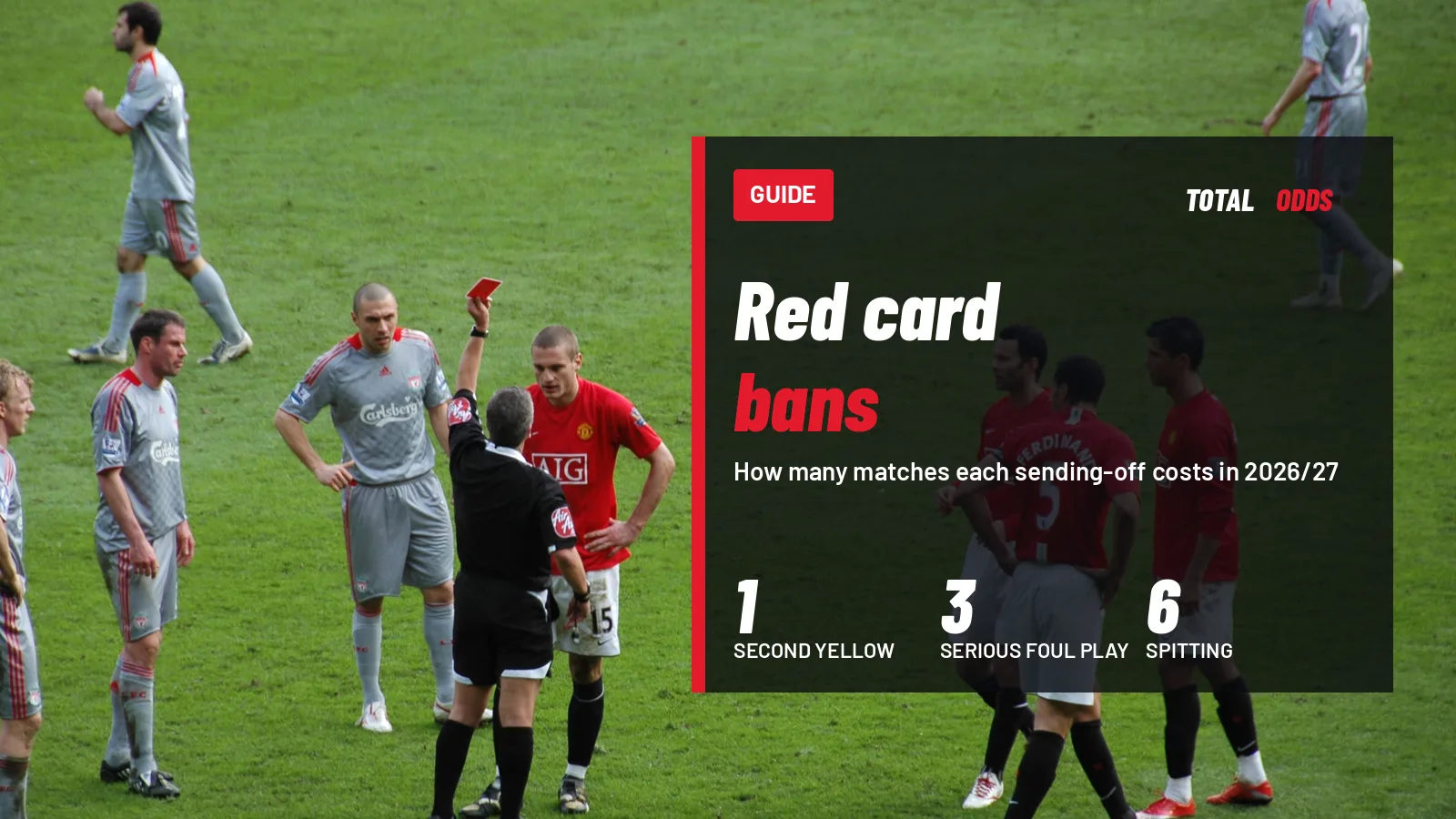
The cover shows referee Alan Wiley showing a red card to Nemanja Vidić during Manchester United against Liverpool at Old Trafford on 14 March 2009. Photograph by Sdo216, CC BY-SA 3.0, via Wikimedia Commons. TotalOdds cropped and shaded the photograph and added the headline and logo; the adapted cover is shared under the same licence.