




























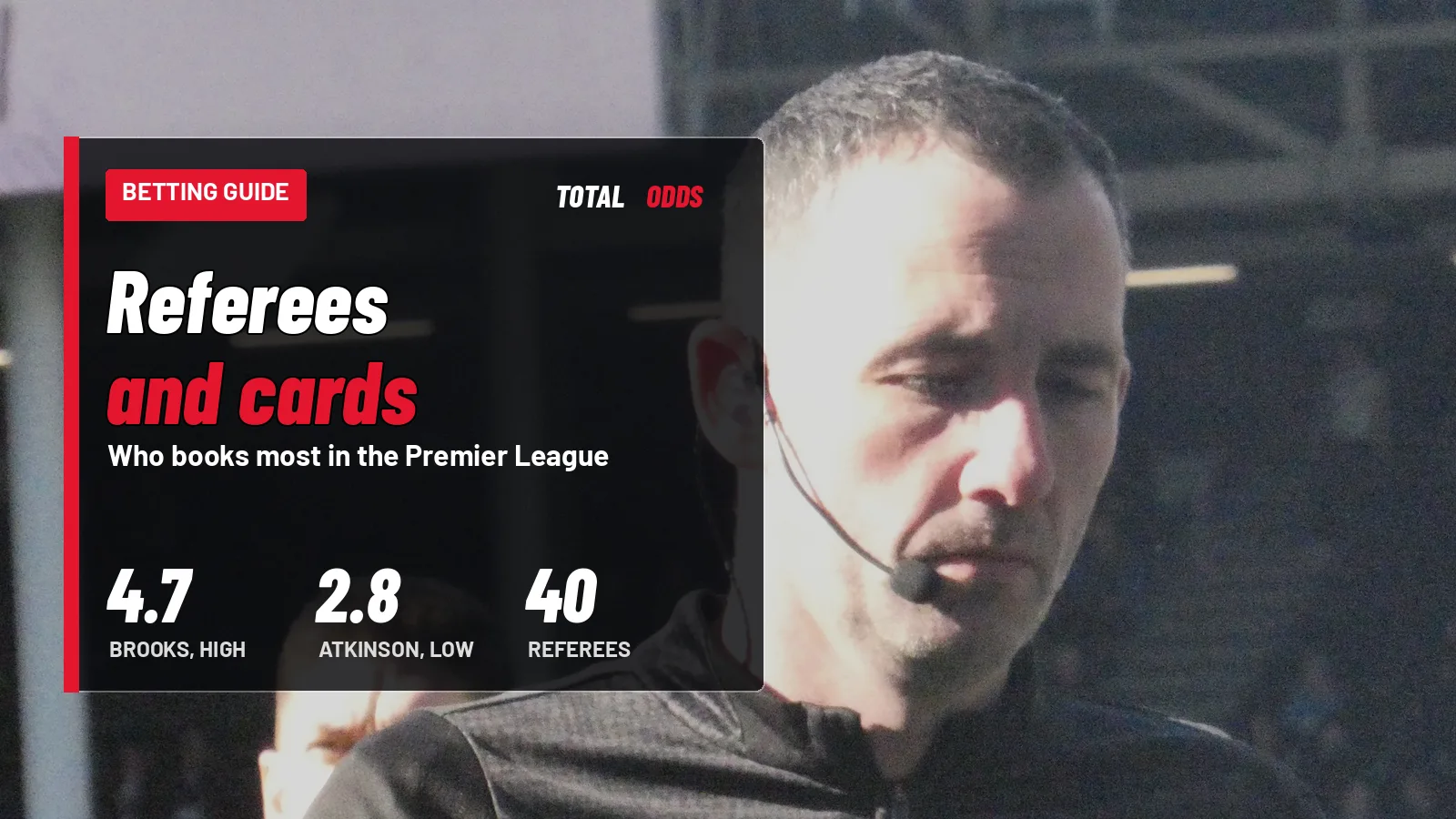
Some referees reach for their pocket early and often, and others let games flow until something serious happens. In the Premier League the gap is big enough to move a card market. On our referee pages, John Brooks averages 4.7 cards a game across 80 Premier League matches, while Martin Atkinson averaged 2.8 across 113. That is nearly two cards a game between them. This guide explains how card bets work, which referees book most and least, why the league-wide rate has climbed, and what team figures add to the picture. Everything here comes from our referee and cards pages, which cover the Premier League from 2018/19.
How card markets work
The usual card bet is over or under a total, such as 3.5 or 4.5 cards in the match. Bookmakers also offer booking points, team cards, the first player to be carded and anytime card bets on named players. Booking points usually score a yellow card as 10 points and a red as 25, though the exact scale and the treatment of a second yellow vary, so read your bookmaker's rules. Check whether cards shown to substitutes or coaches count, because rules differ. Bets are normally settled on the 90 minutes plus stoppage time. The market sounds simple, but it has one feature goals markets lack: one person, the referee, controls the outcome, and that person's habits can be measured.
The league rate has climbed
A referee's average only means something next to the league average of the time. Our season tables put the Premier League's cards per game at 3.33 in 2018/19, 3.47 in 2019/20 and 2.99 in 2020/21, then 3.51, 3.66 and a peak of 4.32 in 2023/24. Since then the figures have been 4.19, 3.85 and 4.28 so far in 2026/27, after 10 rounds. In other words, the rate this season is higher than in any of the first five seasons on record. A referee who averaged 3.5 in 2021/22 was right on the league rate, while 3.5 today would be well below it. That is why we show each referee's rate beside the league's for every season, and why a lifetime figure on its own can mislead.
Who books most, and who books least
Among referees with at least 50 Premier League matches on our records, Brooks is the highest on 4.7 cards a game. Peter Bankes is next on 4.1 in 121 matches, then Stuart Attwell, David Coote, Darren England and Mike Dean, all on 4.0. Dean also has the highest red card rate in that group, 0.21 a game, roughly one every five matches. At the other end, Atkinson and Graham Scott are both on 2.8, ahead of Andre Marriner on 2.9 and Jonathan Moss on 3.1. The two busiest officials sit between those extremes: Anthony Taylor has 3.7 cards a game in 239 matches and Michael Oliver 3.4 in 232. One caution: several names on the list last worked in the Premier League some time ago, and each profile shows its date range.

One referee in detail
Brooks is a good test of whether a high average is real. Our season table puts him above the league rate in five of the six Premier League seasons on file: 5.2 against 3.51 in 2021/22, 4.3 against 3.66, then 5.4 against 4.19 in 2024/25 and 4.1 against 3.85 last season. The exception was 2023/24, when his 4.2 sat just under the league's 4.32. This season he has had six matches and 38 cards, an average of 6.3 against the league's 4.28. That includes nine cards in Sunderland's 0-2 home defeat by Arsenal on 12 September and nine in Brentford v Liverpool on 17 October. Across all 88 games on his profile, home sides have had 2.49 cards a game and away sides 2.16. Six games is a short run, but it points the same way as the long record.
Clubs matter too
A referee does not book anyone alone. Our Premier League cards table shows each club's own record and how often its opponents are booked. Newcastle collect the most cards, 3.00 a game from 26 yellows and one red in nine matches, against a league average of 2.14 a team. Coventry are the lowest on 1.22. Opponents of Arsenal and Chelsea are booked most, on 3.44 a game each. The splits add detail: Hull have been shown 3.75 cards a game away from home, from 15 yellows in four matches, but only 1.80 at home. Put a high-card side against a team that is fouled a lot, under a referee with a high rate, and a total of 4.5 looks very different from one on a calmer afternoon.
Putting it together
A simple routine keeps the numbers honest. First, find the referee: the fixture page has a Players and Referee tab, and the appointment should be checked again close to kick-off in case of a change. Second, open the referee's page and compare their cards per game with the league average in the same seasons, not only their career figure. Third, check both clubs' cards for and against in the cards table. Fourth, ask what the match is: derbies, relegation fights and games that are one-sided from early on all change how often referees reach for the card. After that, compare your view with the bookmaker's line. We do not carry card prices on our fixture pages, so compare them at the bookmakers and check the line against the totals above.
Using our pages
The Premier League referees page lists every official with a profile for cards, yellows, reds, goals and corners per game, and John Brooks and Martin Atkinson show the extremes in full, with every match they took. Read the figures for officials with only a handful of games with care. A referee with five matches on file, such as Matt Donohue at 5.6 cards a game, tells you very little yet. Our guide to shots and shots on target covers another set of match figures worth reading alongside cards.
Bet responsibly
Odds are a bookmaker's view of the chances, not a promise, and no market removes the risk of losing. Only bet what you can afford to lose, set limits before you start, and never chase losses. Betting is for over-18s. If gambling stops being fun, contact the National Gambling Helpline on 0808 8020 133 or visit BeGambleAware.org. More about how TotalOdds works is on our about page.
Photo credits
The cover shows referee Chris Kavanagh at Craven Cottage on 21 March 2026, before Fulham v Burnley. Photograph by Timmy96, CC0, via Wikimedia Commons, cropped and adapted with text. The second picture shows referee Robert Jones arriving at Craven Cottage on 24 May 2026, before Fulham v Newcastle United. Photograph by Timmy96, CC0, via Wikimedia Commons, cropped.