





































































Over 1.5 goals is the bet most punters reach for when they want something that feels safe. Two goals between two teams in 90 minutes. No need to pick a winner, no sweating over a late equaliser, and in most leagues it lands about three times in every four games. That is exactly why it fills so many weekend betting slips, and exactly why it catches so many people out. A short price that wins often can still lose you money over a season. This guide sets out a popular over 1.5 goals strategy, step by step, using real numbers from our league and fixture pages, and covers how to use it for singles and accumulators.
What over 1.5 goals means
Over 1.5 goals wins if the match finishes with two or more goals, scored by either side. A 2-0, a 1-1 and a 4-3 all count. Under 1.5 wins at 0-0 or a one-goal game. Own goals count, stoppage time counts, extra time and penalty shootouts do not. Because the line ends in a half, there is never a refund: one side of the bet always wins. It sits between over 0.5, which only needs one goal and is priced as a near certainty, and over 2.5. That one, the most famous goals line, is covered in our over/under 2.5 goals guide. The appeal of 1.5 is the middle ground. A game that finishes 2-0 or 1-1 is a winner here and a loser on over 2.5, and those scorelines are among the most common in football.
Why the strategy is so popular
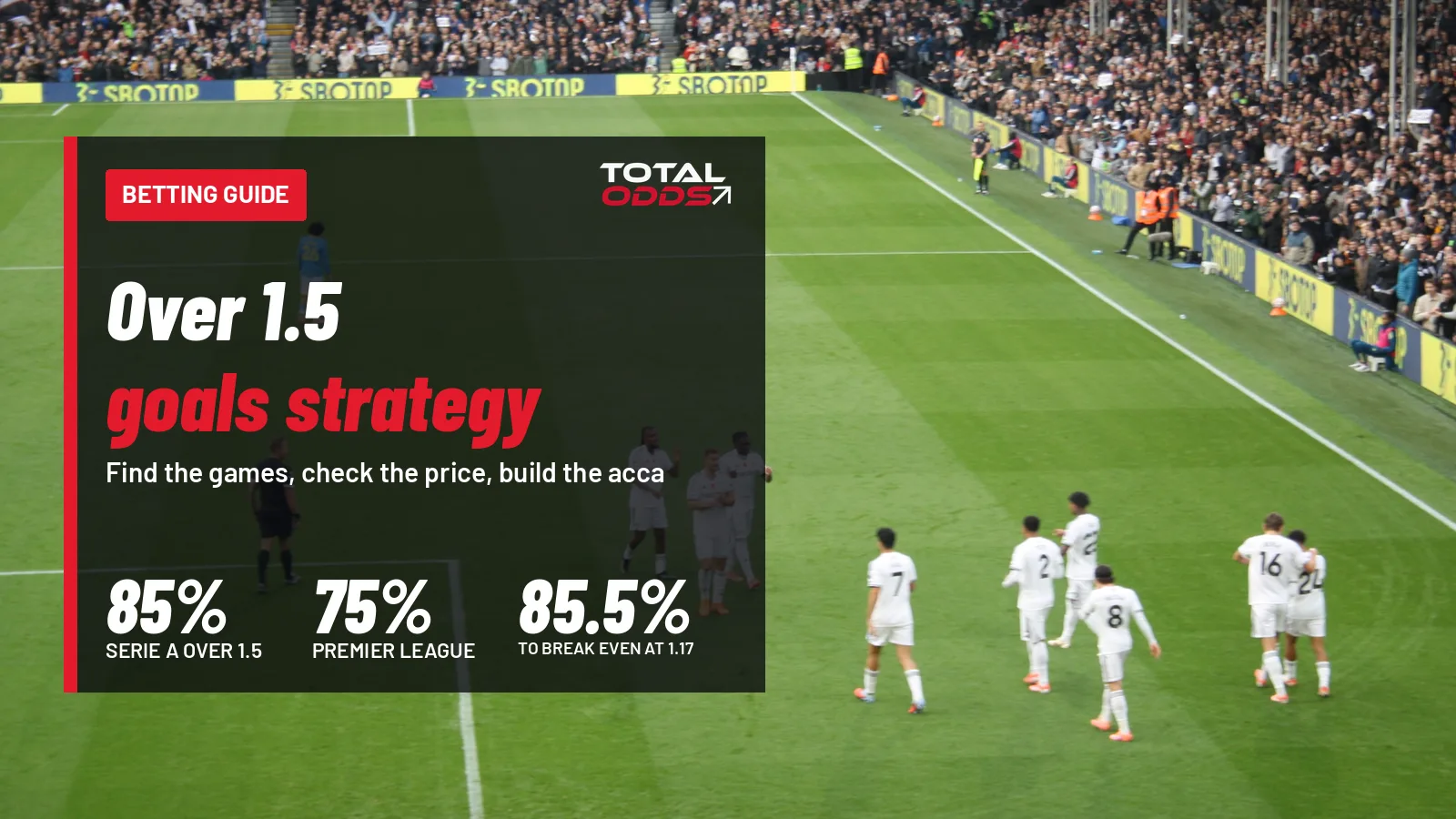
Our over/under tables show how often two goals arrive. This season 85 per cent of Serie A games have cleared 1.5, 81 per cent in the Bundesliga, 80 per cent in Ligue 1, 78 per cent in the Championship, 76 per cent in La Liga and 75 per cent in the Premier League. Win rates like that are the whole pitch. But the bookmakers know them too, which is why the price is short. At odds of 1.17 you need the bet to land 85.5 per cent of the time just to break even, and at 1.25 you need 80 per cent. Back every Premier League game blind at 1.25 and a 75 per cent strike rate loses money, even though you would win most weekends. The strategy is not about finding games that go over. Most do. It is about finding the ones where the record is clearly stronger than the price.
Step one: start with both clubs, not one
The most common mistake is backing over 1.5 because one team plays in high-scoring games. A match has two teams, and the quieter one matters just as much. In the Premier League, Brentford matches have cleared 1.5 in all 10 this season, and Chelsea, Ipswich, Crystal Palace, Brighton, Man United and Bournemouth are all on 90 per cent. At the other end, Leeds, Arsenal, Fulham, Nottingham Forest, Hull and Coventry sit on 60 per cent. Brentford are a useful case. Their games average only 2.70 goals and just half have gone over 2.5, yet every one has reached two. That is the profile an over 1.5 backer wants: not wild games, just games that reliably get to two. A simple filter works well here. Look for fixtures where both clubs have cleared 1.5 in at least eight of their last 10, which our fixture pages show in the Previous Game Statistics panel.
Step two: split home and away
Season averages hide a lot. Our tables have Overall, Home and Away views, and the split can turn a good-looking fixture into a weak one, or the other way round. Chelsea v Leeds this Saturday is a clear example. Chelsea's five home league games have averaged 4.20 goals and all five cleared 1.5. Leeds' five away games have averaged 1.60, with only three of the five reaching two goals, and Leeds matches have stayed under 2.5 in eight of their last 10. The price of 1.22 is leaning on Chelsea. Bournemouth v Nottingham Forest works the opposite way to what the headline numbers suggest. Forest's games overall clear 1.5 just 60 per cent of the time, but that comes from their home record: only one of five has reached two goals at the City Ground. Away from home, all five Forest games have cleared 1.5, at an average of 3.00 goals. Always read the venue that applies to the match in front of you.
Step three: check the head to head
Some pairings just produce goals, and some do not, whatever the season form says. The head to head panel on every fixture page lists past meetings and the average total. Millwall v QPR is the over 1.5 backer's ideal. All 10 meetings on our page reached at least two goals, yet only three went over 2.5, for an average of 2.30. That is the sweet spot again. Monaco v Auxerre is even busier: all six meetings had at least three goals, at 4.33 a game. Now compare Napoli v Torino. Torino's matches have gone over 1.5 in all of their last 10, which looks perfect, but six of the 16 Napoli v Torino meetings on our page finished with fewer than two goals, including two 0-0 draws, and the average is 2.06. A strong club trend running into a cagey fixture history is a reason to pause, not to pile in.
Step four: turn the price into a percentage
Once the football checks out, the price decides whether it is a bet. Divide 1 by the decimal odds to get the implied chance. On our fixture pages, updated at 12:55 UTC on Monday 16 November, Bet365 was the only bookmaker quoting the 1.5 line for these games. Millwall v QPR was 1.22 for over 1.5, which implies 82 per cent, and 4.33 for under, which implies 23 per cent. Together they add up to 105 per cent, and the 5 per cent above 100 is the bookmaker's margin. Leverkusen v Paderborn shows the other side of it. Over 1.5 was 1.10, a 91 per cent chance. Leverkusen's games have cleared 1.5 in all nine league matches, but Paderborn's have done so in just five of nine, and two of their four away games. At 1.10 there is almost nothing left to win if the bet comes in, and plenty to lose if Paderborn keep it tight. A short price is only good value when the evidence is stronger still. Our guide to reading football odds covers the conversion in more detail.
Singles: the steady approach
The single bet is where this strategy is easiest to judge honestly. Each selection stands or falls on its own evidence, you know the exact chance you are paying for, and one 0-0 costs one stake rather than a whole slip. The returns are small: £10 at 1.22 returns £12.20, a profit of £2.20. That is why staking discipline matters more here than in almost any other market. Use a fixed stake, the same for every bet, rather than raising it after a win or a loss. Keep a simple record of the price you took and the result. Over 30 or 40 bets you will quickly see whether your selections are landing more often than their prices imply. If they are not, the filter needs tightening before the stakes go up. One loss at these odds wipes out four or five wins, so the job is to keep the losses rare, not to chase bigger returns.
Accumulators: why over 1.5 accas are so popular
Over 1.5 is the classic accumulator leg because the odds are too short to bet on their own. Combine three or four and the price starts to look worthwhile. Using this weekend's prices on our pages, Millwall v QPR at 1.22, Monaco v Auxerre at 1.14 and Lens v Toulouse at 1.20 make a treble of 1.67. Add Lazio v Lecce at 1.17 and the four-fold is 1.95. The catch is in the maths. Multiply the implied chances and the treble is roughly a 60 per cent shot, the four-fold about 51 per cent. Each leg looked like an 80 to 90 per cent bet, but together you are close to a coin flip. The margins stack up too. Each leg carries 5 to 6 per cent, so the acca pays noticeably less than its fair price, and the more legs you add, the bigger that gap gets.
How to build a better over 1.5 acca
A few rules make accas less of a lottery. Keep them short: three or four legs, not eight. Every leg must pass the same checks you would use for a single, so never add a weak game just to bump the price up. Avoid the very short legs at 1.05 to 1.10, because they add little to the return but still carry the full risk of a 0-0. Spread the kick-offs across different leagues so one wet afternoon in one country does not sink the lot. If you like more than four games, split them into doubles rather than one long acca, so a single miss does not cost everything. Some bettors also use acca insurance offers from bookmakers, which refund the stake if one leg lets you down, but read the terms because the refund is often a free bet, not cash. Finally, check the line-ups on the fixture page an hour before kick-off. A missing striker can change a game's goal outlook more than any season average.
In-play: waiting for a better price
A popular variation is to wait. If a match you liked before kick-off is still 0-0 after 20 or 30 minutes, the over 1.5 price drifts, sometimes a long way, because two goals now have to come in less time. Backers who trust their pre-match reading of the game can get odds well above the pre-match price. The risk is obvious: the longer it stays goalless, the less time there is, and a tight first half often means a tight game. Watch what is actually happening rather than the clock alone. Shots, corners and a side chasing the game are signs it could open up. A red card or an early substitute for the main striker can change everything. Each league has a live page, such as the Premier League live page, which makes it easy to keep an eye on several games at once.
This weekend: our betting angle
Taking all four steps together, Millwall v QPR at The Den on Saturday 21 November stands out. Millwall's home games have cleared 1.5 in seven of eight this season, QPR's away games in six of seven, QPR's matches have gone over 1.5 in nine of their last 10, and all 10 meetings on our page reached two goals. Betting angle: Millwall v QPR over 1.5 goals at 1.22 with Bet365. That price was on our fixture page at 12:55 UTC on Monday 16 November. It implies an 82 per cent chance, so this is a low-return bet, and a game between these sides can still finish 1-0 or 0-0. For a treble, Monaco v Auxerre at 1.14 and Lens v Toulouse at 1.20 pass the same checks: Auxerre's away games and Monaco's home games have all cleared 1.5 this season, and Toulouse's five away games have all reached two goals. Prices move, so check them again before you bet.
Mistakes to avoid
Treating over 1.5 as a certainty is the biggest one. A 75 or 80 per cent bet loses one time in four or five, and that will happen, sometimes two weeks running. Chasing a loss by doubling the stake on the next acca turns a normal bad weekend into an expensive one. Backing big names rather than the numbers is another trap, because some of the best-known clubs are in quiet games: Arsenal matches have cleared 1.5 only six times in 10 this season, and none has reached four goals. Ignoring the price is the last. If the odds imply a higher chance than the record supports, leave it, however obvious the game looks. There will be another one next week.
Using our pages to find over 1.5 bets
Start with the over/under goals table for a league, which lists every club's average goals and the share of games over 1.5, 2.5 and 3.5, with Overall, Home and Away views. Then open the fixture page for the game you like. The Previous Game Statistics panel shows how many of each team's last 10 cleared 1.5. The Did you know? box flags the strongest runs, such as Torino's 10 out of 10. The head to head panel gives every past meeting and the average total. The odds card has a line selector for total goals, so click 1.5 to see the over and under prices side by side and work out the margin. Four checks, five minutes a game, and you will be backing selections with evidence behind them rather than a hunch.
Bet responsibly
Odds are a bookmaker's view of the chances, not a promise, and no strategy removes the risk of losing. Short-priced bets feel safe, which makes it easy to stake too much on them. Only bet what you can afford to lose, set limits before you start, and never chase losses. Betting is for over-18s. If gambling stops being fun, contact the National Gambling Helpline on 0808 8020 133 or visit BeGambleAware.org. More about how TotalOdds works is on our about page.
Photo credits
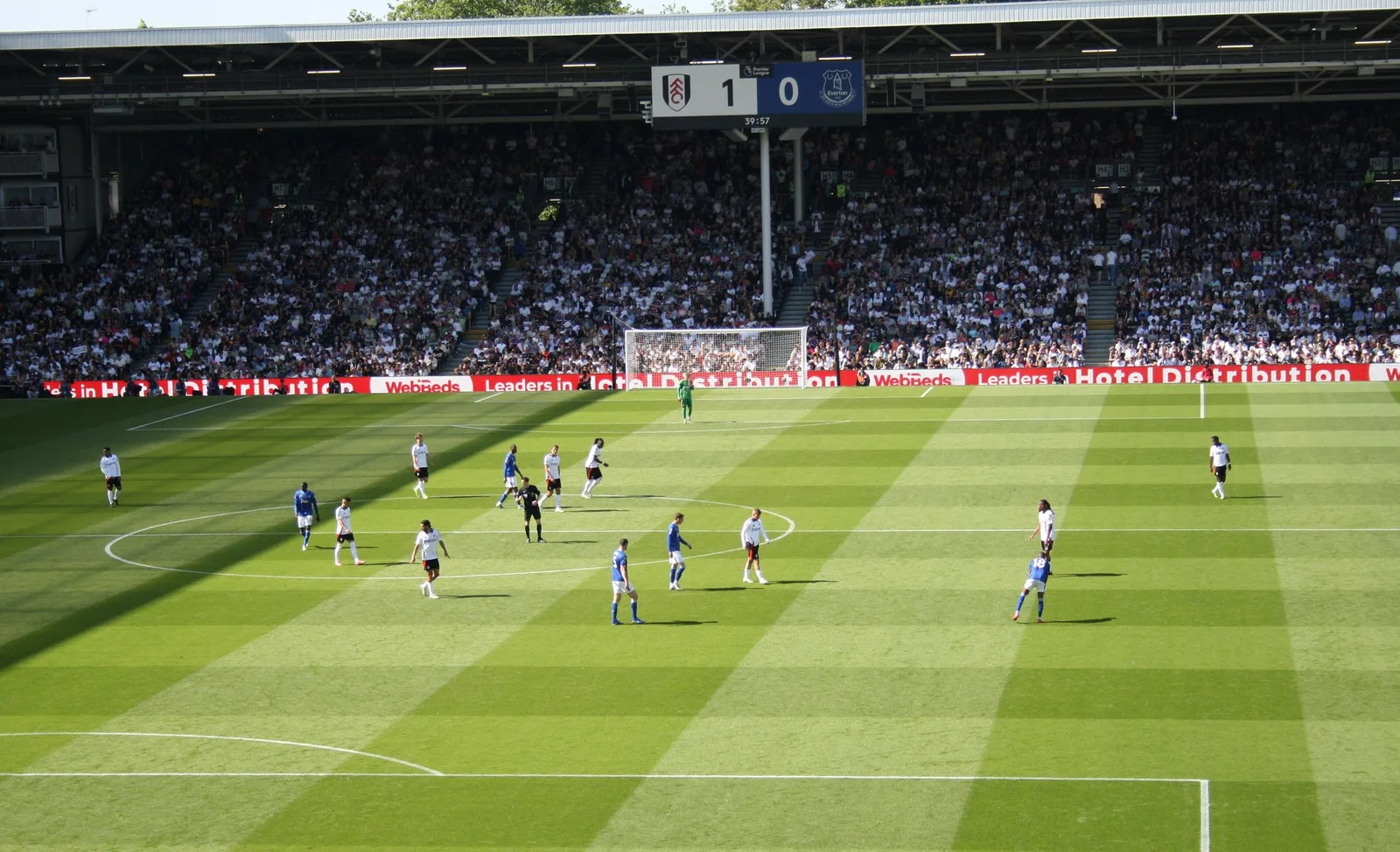
The cover shows Fulham players celebrating a goal against Wolverhampton Wanderers at Craven Cottage on 1 November 2025. Photograph by Timmy96, CC0, via Wikimedia Commons, cropped and adapted with text. The second picture shows Fulham v Everton at Craven Cottage on 10 May 2025. Photograph by Timmy96, CC0, via Wikimedia Commons.